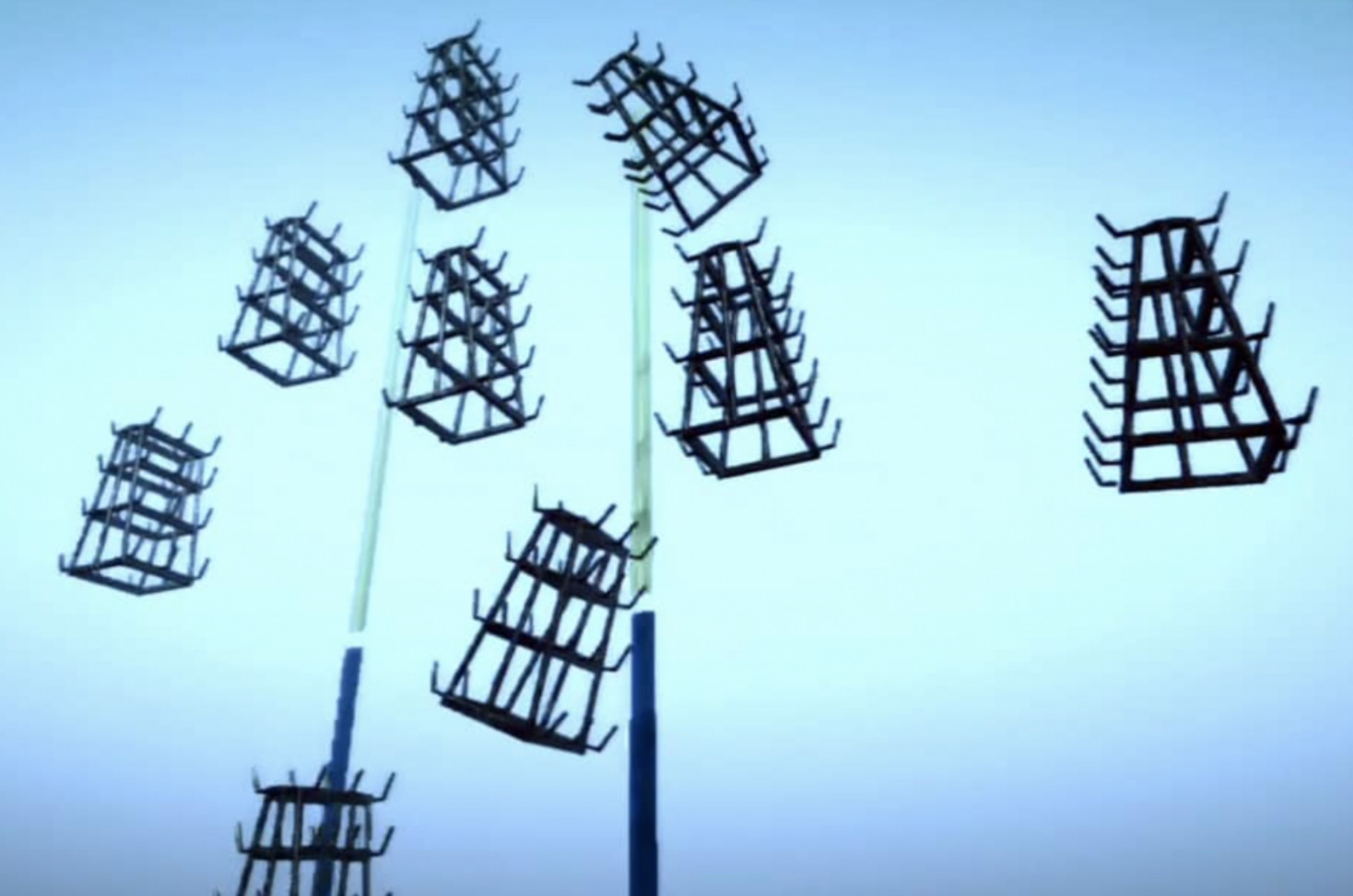
“Another Kind of Spiral” is an algorithmic music composition performed by manipulating a virtual mechanical music instrument. Constructed specifically for 3 compositional iterations, the notes in the piece are emitted as ‘sound objects’ as well as triggered by location in various parts of the immersive space. The machine then algorithmically moves the virtual camera through the space, thereby focusing sonically on the nearest iteration of the composition at any given moment. All the while a pulsing bass line urgently keeps time. Because the camera is attached to a series of rapidly rolling objects, the piece is very kinetic and the composition shifts frequently.
Music composed by Tamara Yadao. Performed by foci + loci (Chris Burke + Tamara Yadao), BPI, Centre Pompidou, 2015. Special thanks to Mélanie Archambaud, Renaud Ghys, Isabelle Arvers and Laurent Chalet.
‘Another Kind of Spiral’ was made possible by a grant from the American Composers Forum with funds provided by the Jerome Foundation.
“Descen” is a formal experiment with the mechanization of immersive space. Timed and triggered audiovisual events and the gravity of falling objects (induced by the space’s own physics) determine music compositions spatially. Knowable Space is meant to be an abstract musical work (both structured and algorithmic) that actualizes itself physically relying on the programmed behaviors of emitted objects and cameras.
“Descen” is the second section from a larger map or piece called Knowable Space. This piece was performed and premiered live at the opening exhibition for Game Art in the Knowable Space curated by Chris Burke for Culturehub in 2014.
Like “Descen”, “Sky Speakers 1” is a formal experiment with the mechanization of immersive space. Timed and triggered audiovisual events determine music compositions spatially by the movement of physical objects in space (i.e. cameras). Knowable Space is meant to be an abstract musical work (both structured and algorithmic) that actualizes itself physically relying on the programmed behaviors of emitted objects and cameras.
“Sky Speakers 1” is the first section from a larger map or piece called Knowable Space. This piece premiered and was performed live at the opening exhibition for Game Art in the Knowable Space curated by Chris Burke for Culturehub in 2014.
Also a mechanized immersive space, “Sky Speakers 2” incorporates groups of chordal sound objects installed in virtual space, performed using camera movement. Unlike “Sky Speakers 1”, there is more freedom to improvise as chords are not necessarily meant to create specific phrases. This is also a formal piece experimenting with sound spatialization.
Sarunay Signifiers for Spatial Scoring in Unreal Engine
All Little Big Planet spatial/algorithmic compositions I have made are relevant to the next series of mechanized music maps in ideation I will create using Unreal Engine. Because of UE’s terrain-building capability, I am interested in using my visual sarunay signifiers with an archipelago terrain, ostensibly a simulation of the Philippine islands. I learned about visual mapping from Susie Ibarra, who uses visual shape signifiers to map cipher notation to her drums. I would like to map my sarunay signifiers as cipher notation to a virtual terrain, creating either an algorithmic score or sarunay composition. An example of island terrain I would use in an archipelago construction is below. As I also intend to simulate certain aspects of nature, like the ocean for example, I will experiment with applying the rhythms in my nature recordings either conceptually or literally to these simulated aspects of Philippine nature.
Example of Island Terrain - Unreal Engine 5
Courtesy of Smart Poly YouTube channel
Simulation of Particle Synthesis and Emergent Behavior
using the Little Big Planet Game Engine
"Pod 1"
This lecture/presentation given at Dartmouth College A/V Synthesis Conference in 2015 demonstrated a process by which independent objects generated particle synthesis via attraction and repulsion. Objects were programmed with interactive characteristics and sound objects using the LBP extensible toolset. Systematically with each progressive pod, we see more interaction among particles, thereby causing emergent behaviors — or what I call “behavioral glitch”.
(Like Max/MSP, for example, LBP as a program is modular, has its own lexicon one can learn through building practices using its toolsets, libraries of devices and audio samples.) The LBP tools that enable objects to have basic attractive/repellent characteristics include: tags, tag sensors and followers (that also have the capability to flee).
Simulation of Particle Synthesis and Emergent Behavior
using the Little Big Planet Game Engine
"Pod 2"
This lecture/presentation given at Dartmouth College A/V Synthesis Conference in 2015 demonstrated a process by which independent objects generated particle synthesis via attraction and repulsion. Objects were programmed with interactive characteristics and sound objects using the LBP extensible toolset. Systematically with each progressive pod, we see more interaction among particles, thereby causing emergent behaviors — or what I call “behavioral glitch”.
(Like Max/MSP, for example, LBP as a program is modular, has its own lexicon one can learn through building practices using its toolsets, libraries of devices and audio samples.) The LBP tools that enable objects to have basic attractive/repellent characteristics include: tags, tag sensors and followers (that also have the capability to flee).
Simulation of Particle Synthesis and Emergent Behavior
using the Little Big Planet Game Engine
"Pod 3"
This lecture/presentation given at Dartmouth College A/V Synthesis Conference in 2015 demonstrated a process by which independent objects generated particle synthesis via attraction and repulsion. Objects were programmed with interactive characteristics and sound objects using the LBP extensible toolset. Systematically with each progressive pod, we see more interaction among particles, thereby causing emergent behaviors — or what I call “behavioral glitch”.
(Like Max/MSP, for example, LBP as a program is modular, has its own lexicon one can learn through building practices using its toolsets, libraries of devices and audio samples.) The LBP tools that enable objects to have basic attractive/repellent characteristics include: tags, tag sensors and followers (that also have the capability to flee).